
One of the things I learned while I was in seminary was how to make an amazing hamburger. At the time, I was on a friend’s patio. He was grilling what I was soon to discover was the best burger I’d ever tasted. With the first bite still in my mouth, I mumbled something like, “How did you do this?” and he showed me how.
As they grew up, my kids loved these hamburgers. They’d come home from college and want at least one meal of “Dad’s hamburgers”. They learned how to make them and told me stories of the first time they made them for someone else.
Today my grandkids love McDonald’s®. More than Burger King®, more than Wendy’s®. Chic-Fil-A® actually comes in a distant fourth place. I can offer to make them “Dad’s (Papa’s) burgers” but they want McDonald’s®. I haven’t made them Dad’s burgers for quite a while because I understand the present and future of this effort based on Bloom’s Taxonomy. Really.
While this is not an exhaustive exercise, let’s compare these two burgers:
Dad’s Burgers
- Less Expensive
- Take longer to make
- Able to vary size
- Able to vary doneness
- Surprising taste
- Variety of items to add to the beef mixture along with the a greater variety of optional add-ons
Fast Food Burgers
- More Expensive
- Faster to the window
- Same doneness
- Same Taste
- Standard variety of optional add-ons
The Future of Dad’s Burgers
As one matures, there is greater value and enjoyment of a Dad’s Burger. I know that as my grandkids mature – as their palate matures – they will love Dad’s burgers more than McDonald’s®. And then they will join the growing line of heirs in my lineage that make them for themselves.
And many whom they make them for who will have the same “How did you do this?” experience and want to learn how to make their own.
My son’s burgers are no longer called Dad’s Burgers. He knows they are, but when he makes them, they are his burgers. Those who enjoy them call them Jesse’s Burgers. And they are his because he has tweaked the recipe. AND he makes them himself.
The pattern will continue.
People will learn how to make their own
- They will tweak the recipe to what works for them.
- They will serve them to others.
- Who will learn how to make their own.
- After learning, these people will show others how to make THEIR own
- Consumers become Contributors
- Contributors become Creators
My kids and grandkids will know that Dad passed something memorable on to them in such a way that they can pass it on to others.
The Fast Food Future
As one matures, the less value and enjoyment there is (How many adults with grown kids go to McDonald’s® when there are no grandkids with them?)
- Nobody asks McDonald’s®, “How did you do this?”
- Nobody is looking for the recipe so they can make their own.
- All they want is something that is easy to consume.
- Consumers continue to only consume.
- Kids and grandkids will always know you get your burgers at McDonalds.
Fast food chains have done a masterful job of marketing their wares to the paying consumer and the feeding consumer.
Three Values for the one Paying
- Speed
- Consistency
- Convenience
Two Values for the the one Consuming
- Kid Palate flavor (No Flavor Surprises)
- Toys…uh… fries on the side
The question is not “Where is your church getting your burgers?” (the meat of discipleship). It is, instead, “Why in the world are you getting your burgers where you do?”
I have to tell you, as one who believes in replicating leaders, I find great satisfaction knowing that generations of Bernard’s are going to be making burgers because one Bernard learned how to make them from someone not a Bernard.
In the same way, I take tremendous joy in knowing that there are those in my life that have allowed me to show the way past the kid’s menu.
Never heard of Bloom?

This is not uncommon unless you have a education degree. But, if you are serious about growing mature disciples, beyond the Bible itself, there is no better place to start.
“In 1956, Benjamin Bloom with collaborators Max Englehart, Edward Furst, Walter Hill, and David Krathwohl published a framework for categorizing educational goals: Taxonomy of Educational Objectives.
Familiarly known as Bloom’s Taxonomy, this framework has been applied by generations of K-12 teachers, college and university instructors and professors in their teaching. The framework elaborated by Bloom and his collaborators consisted of six major categories: Knowledge, Comprehension, Application, Analysis, Synthesis, and Evaluation. The categories after Knowledge were presented as “skills and abilities,” with the understanding that knowledge was the necessary precondition for putting these skills and abilities into practice.”[i]
In 2001, Bloom’s 6 categories were updated to use action words, rather than nouns, to describe these categories. This was done to better emphasize the dynamic process of thinking and learning outcomes.
To illustrate this, an unborn child has the ability to gain knowledge. Stories abound of how newborns recognize the sound of their mother’s and father’s voices and are quickly comforted by being held by mom or dad. That child, in the womb “learned” that which they could not even begin to comprehend. For the newborn, these are concrete facts without question. This concrete learning ability continues from newborn through childhood. We’ve all watched children progress through these stages, even if we did not know about Bloom.
Bloom and the Bible
Imagine with me, for a moment, that all of mankind – from the beginning with Adam and Eve, to the end when Jesus returns – is in many ways like a single life that was born, is growing, and will pass away. God brought into His creation this infant that He called “Manny”, with the plan that “Manny” would grow into a mature brother for His Son, gladly serving with Him in the family ministry. That child would progress very much through the very same stages of development that God put into a human child.
Without belaboring the analogy too deeply:
The nation of Israel was the child of this “humankind”. God told them what to do, where to go, and where not to go. I can just hear God telling them, “Don’t play in the street” or “Don’t run in the parking lot” or “You better hold my hand!”
Children need lots of “no’s”, “don’ts”, and hand-holding if they are to survive childhood. And they also resist, resent, and rebel at such instructions. The Old Testament is the Law with good reason. Humankind was an infant/toddler, prone to wander and disobey.
Punishment was common. Death for this, death for that, banishment for this, banishment for that. Don’t come to the table with dirty hands. Leviticus makes it pretty clear that, while God chose the Jews, once He did, they really had no choice; follow or die.
Believers of today, on the other hand, are more mature (not more perfect) in this analogy. Believers, because of Christ’s actions:
- Choose to believe
- Obey without threats
- Are Saved by Grace rather than Saved by applying the Law
- Serve in the family business as the returned Prodigals that we are
As with any “child”, in the beginning, they have very little choice. Parents don’t teach them an academic list of what is right and wrong – the child learns what is right (by affirmation) and wrong (by discipline). But the child doesn’t possess the list, nor the ability to comprehend the source or implications of why something is right or wrong. They can only obey or disobey their parents. They are certainly “learning”. In this stage of development, they gain much knowledge. They remember vast quantities of what they are told. Through the experiences of “applying what they have been told”, they understand the consequences and rewards of the specific instructions, but they still cannot
- Comprehend the reasons why the rules exist
- Analyze various variables and nuances that make the rules right in some cases and wrong in others
- Know, remember, or understand any instruction that they have not been given
Back to the Burgers
Bible Study and Small Group curriculum are often much like the Fast Food restaurants of discipleship. Leaders and churches look for something that is
- Fast – easy to prepare and lead
- Watch a DVD
- Ask the questions provided in the back of the book
- Convenient
- contains commentary
- contains lesson plans
- contains life application suggestions
- Consistent
- Same lesson structure every time
- Safe – no chance of doctrinal error
Small groups struggle to develop world-changer disciples. This struggle is not due to the lack of interest in spiritual growth. Small groups often fail this assignment because there is no growth offered past application. Yet God has made us like Him. He has given us the ability to analyze and evaluate. His desire is for His Word to be synthesized into the core of our beings, yet we continue to provide experiences where adults are challenged to only read, remember, and apply. The price we pay for this includes:
- As one matures, the less value and enjoyment there is with the standard fare. Many adults drop out of such experiences.
- Of those that remain, all they want is something that is easy to consume.
- Nobody is looking for the recipe so they can make their own.
- Consumers continue to only consume.
- And nobody asks “how did you do this” because they don’t want to, or see no need to, do this for themselves.
Would you like to see real lives changed by real Biblical engagement? Lead your people to the path of synthesis. On this path, you won’t need to make up ways to apply God’s word to their lives – the Holy Spirit will apply God’s word. They will comprehend because they have analyzed and evaluated what God is saying to them in the very Word of God. Lives so engaged allow the Word to be what it says of itself; it will do the joint and marrow work it says it will do.
How can you expect to develop Spiritually mature disciples that can evaluate, analyze, and live with God’s word synthesized in their lives if what you’re offering is experiences that focus on remembering, understanding, and applying?
An Updated Recipe
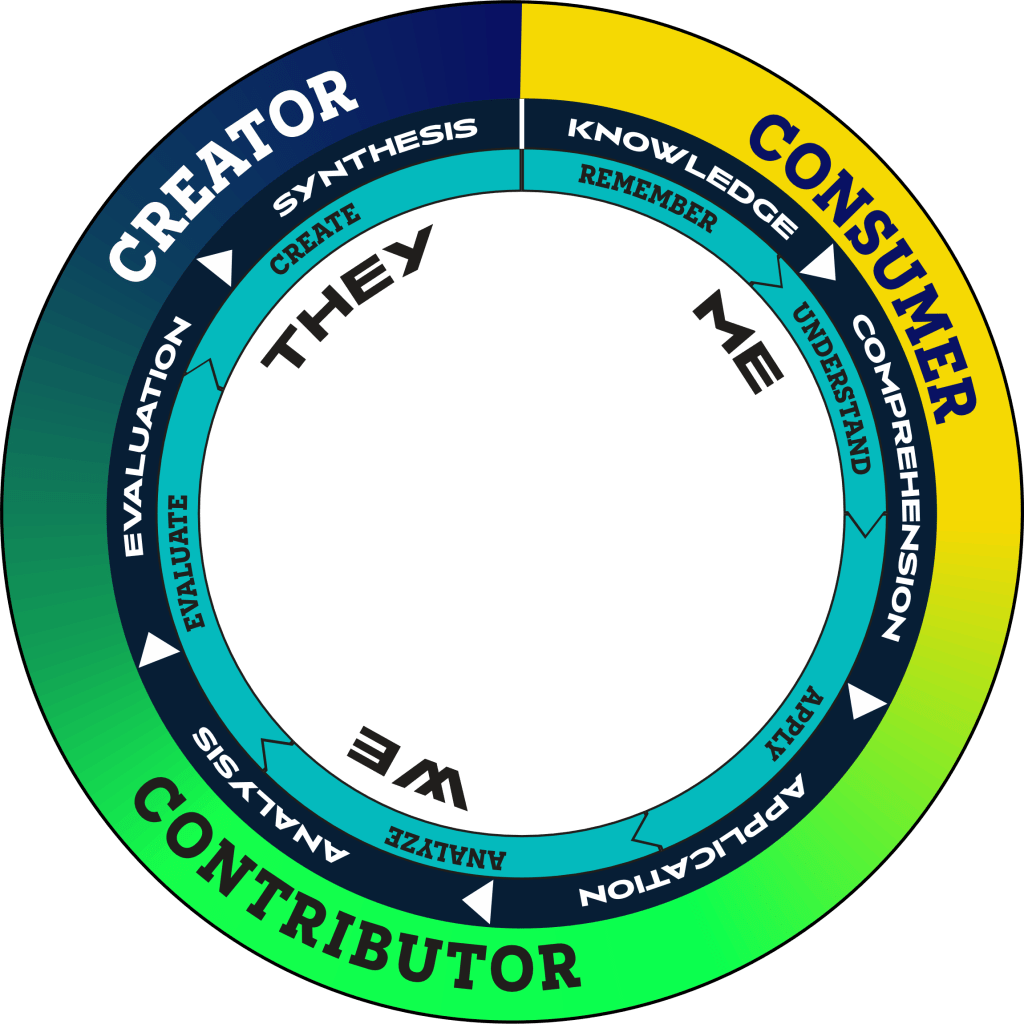
Children and the spiritually less mature are consumers. Almost certainly you have had the consumer vs contributor (me vs we) conversation at your church. If not you, then likely your leadership staff has. It is a sure reality that if you are providing experiences that by their very nature align with the less mature stages of development, that you will continue to generate less mature believers. Having them read more, remember more, and apply more will not make them more mature. It will make them more tired and less excited about what God might be able to do in their lives.
Is it any wonder that the fastest growing religious group among protestant/evangelicals is those that are dropping out of church. They learned during the pandemic that they can read, remember and apply with on-line (drive-thru) services – they can get their fast food anywhere or nowhere.
The sold out/mature Christian life is not about me or we – it is about they. What would your church be like if 10% of your members were in the evaluation/synthesis stage of spiritual maturity? What if they were creating ministry out of what God was doing in their lives, rather than returning to the same fast food menu that has existed for years?
It is Rare for any Curriculum to Hit this Mark
The vast majority of people in small groups are “consumers”. They are not there for God to make them into chefs… to dig into their joint and marrow and change their lives. They are there because “God made us to be in community”, “do life together”, or whatever today’s popular jargon is. The point is that there would not be enough churches or group leaders that would be interested in learning a less controlled, less content provided method for growing disciples. They would be uncomfortable with opening the doors for conversations of analysis and evaluation because those conversations could go anywhere. And finally, they are not sure that they could continue to guide the conversation to and through Biblical truth. After all, they have spent years studying what to say according to what the curriculum tells them to say.
And because it is rare to know how to go on this next stage of the developmental journey, a publishing house would be hard pressed to make any kind of necessary profit on small sales numbers. So, the materials do not exist in any significant quantity.
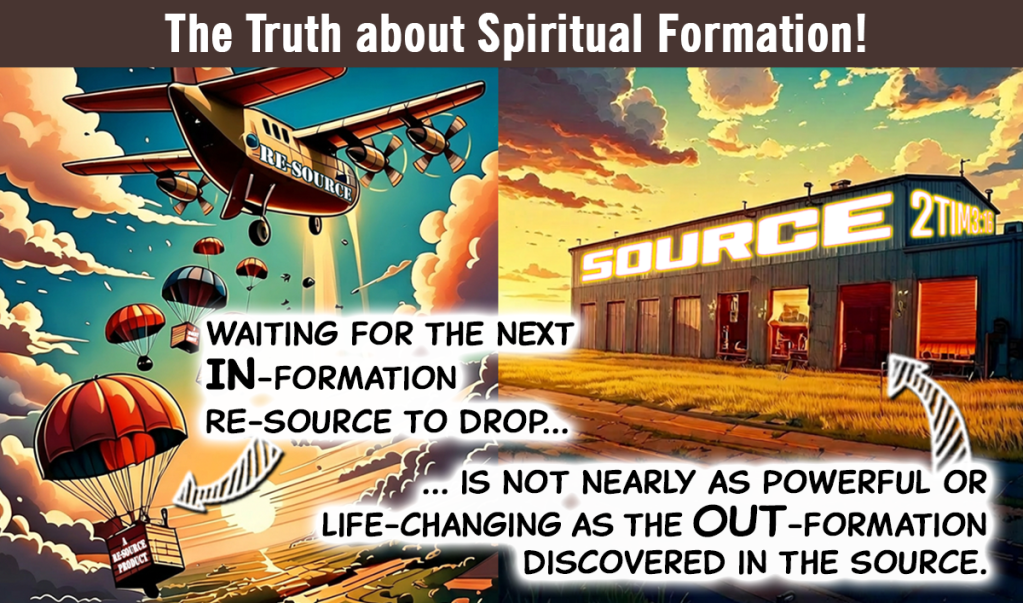
But you don’t need curriculum. You already have the Word of God and years of preaching and Bible Study in your favor. What you likely don’t have is a method/framework (See Framework).
Solomon’s Quest can show you how to maximize all that you have learned in all of the Sermons, Quiet Times, Bible Studies, and in life itself, into thought-provoking, conversational, Biblical, life-changing Bible experiences. You will find yourself in a group with Christ at the center of the conversation.
And like Dad’s Burgers,
- the process will soon become your own
- you and they will be surprised at the experience
- others will wonder how to do it
- you will show them, and the will do it for others
- Consumers will become Contributors
- Contributors will become Creators
That. Is doing life on purpose, together.
Go to solomonsquest.org and request a phone appointment to see how we can help you move past the kids menu, too!
Check out solomonsquest.org for contact information.



 Solomon's Quest
Leave a comment